Showing posts with label Charles Dickens. Show all posts

Friday, June 12, 2015

A Tale of Two Cities (1958)

As film popularity goes, A Tale of Two Cities is a mid-level Dickens novel. Oliver Twist, Great Expectations, and A Christmas Carol have been filmed so many times that it just isn't Christmas without one of them coming out.

Bulkier novels like Bleak House, Our Mutual Friend, and Little Dorrit have been relegated to the small screen. But while A Tale of Two Cities is easily Dickens's best-selling novel (according to Wikipedia, the second best-selling novel of all-time), its cinematic footprint is fairly meager. The last Hollywood version was this one, in 1958, and it was an uneven remake of the 1935 version.

As plots go, it's far easier to summarize than the average Dickens, and with its romance, action, and melodrama, it's prime stuff for an epic film. (In fact, there is a new version in the works.)

Hey! Young Christopher Lee!
The story opens with a carriage struggling up a muddy hillside in the night. A rider approaches through the mist, crying out for one of the passengers, a Mr Jarvis Lorry. The coachmen check with their clients - it's not the handsome, sardonic lawyer, Sydney Carton (Dirk Bogarde), but a fussy banker (Cecil Parker).

After receiving the odd message ("Recalled to life?"), Mr. Lorry continues to Dover, where he informs young Lucie Manette (Dorothy Tutin) that her long-lost father, Dr. Manette (Stephen Murray) has been found alive. After eighteen years in the Bastille, he has been released to some kindly friends: the Defarges.


Saturday, February 28, 2015

Episode 10: What the Dickens?


Why was Charles Dickens so popular? Did he write fairy-tales? Does the Patriarch like Taylor Swift? Why are joy and happiness not the same thing? What is our dream cast for the upcoming miniseries adaptation of A Tale of Two Cities? All this and more in the latest episode of The Pilgrim's Podcast.

Sunday, December 14, 2014

Episode 5: A Christmas Carol - All that Glitters

George C. ScottAlistair Sim's Scrooge was less a cruel miser than a miserable man, making him a character we actually wanted to see change.

We talk about two Scrooges: Sim and Scott. Also: South-West Virginia, The Muppets, putting the mass back in Christmas, favorite Dickens names, Mrs. Crachit’s divine pudding, and the cruelty of government charity.


Sunday, July 13, 2014

Our Mutual Friend (1998) - Review

“I was just playing a part.”

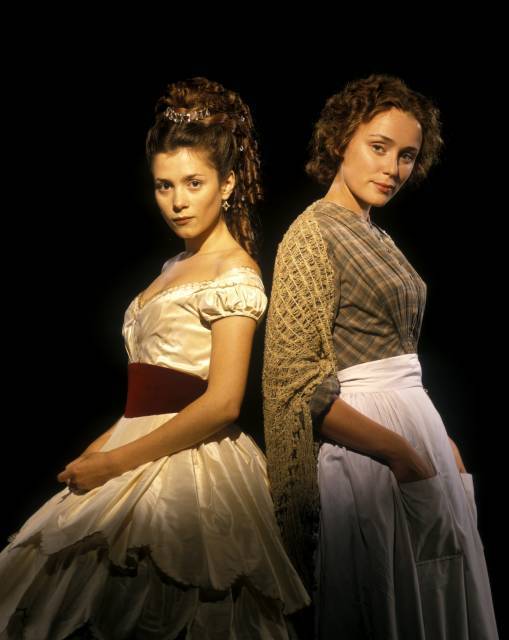
G.K. Chesterton once said that Charles Dickens was the poet of the fog. Nowhere is it more evident than in Our Mutual Friend, a massive, rambling tale of money, and murder amid the murky mists of the Thames. 

It's about honesty, and true love. But also, it's mostly about stalkers (there are seven). And not only dudes obsessed with beautiful women, but greedy rogues tracking down any embarrassing secrets in the lives of rich public figures, or jealous rivals shadowing their opponents.

Dickens was already fascinated by the idea that we cannot really know what goes on inside the hearts of our fellow men, and Our Mutual Friend further complicates this theme by incorporating the devious facades of high society and its occupants. 

Saturday, January 11, 2014

A Tale of Two Cities (1935) - Movie Review


"Mild He lays His glory by
Born that man no more may die
Born to raise the sons of earth
Born to give them second birth"

-Hark the Herald Angels Sing


Let's face it, A Tale of Two Cities is my favorite book. Thus, any adaptation is inevitably going to suffer from my extremely high expectations. My favorite may very well be The Dark Knight Rises. Kidding. Sort of. As of yet, no film version has come even close to my idea of How It Should Be (my screen-play is in the works, so keep an eye out, Hollywood), but the 1935 film is a pretty good attempt.

It's helpful with this film to have some familiarity with 30's movies. Considering it as among its fellows, it was very much ahead of its time, with clever cinematography, a tight script, a huge budget, and a decent cast. Of course, its greatest weaknesses are when it adhered to the then-common conventions, such as the ubiquitous sappy music, the occasionally choppy editing, and a one-dimensional female heroine.