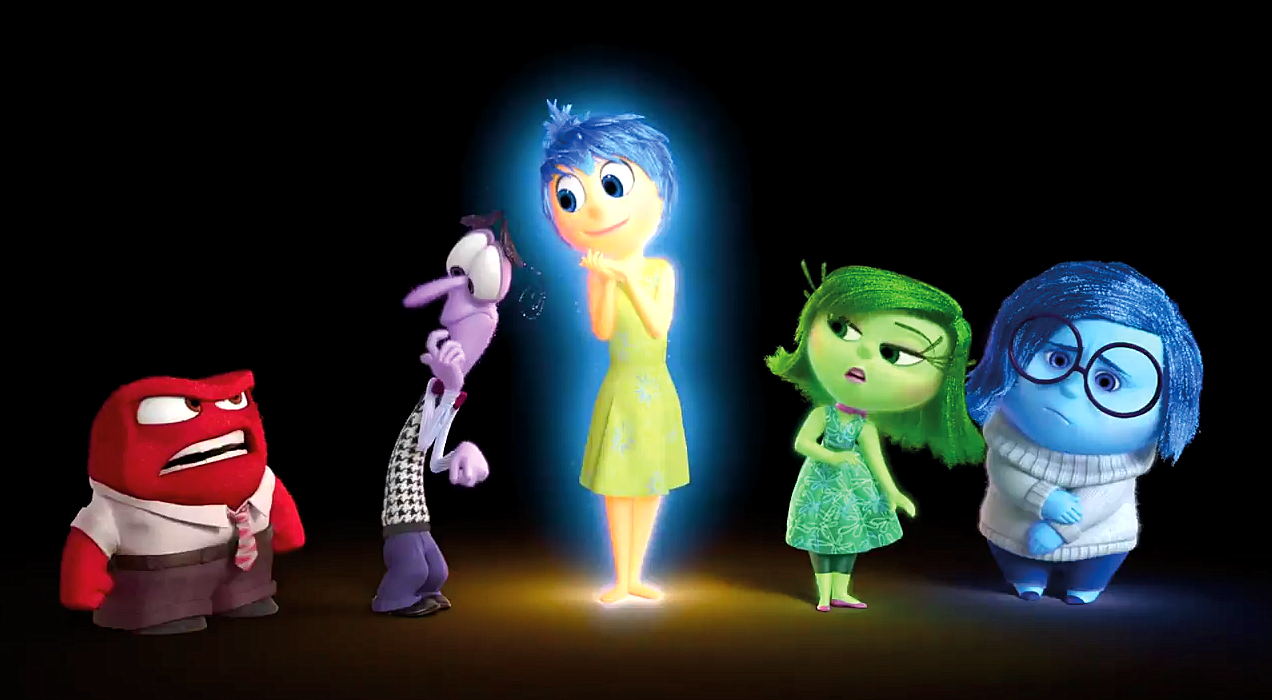
 If there's anything that can be said about this film, it's that it's by far Pixar's most emotional movie to date. Hehehehe...sorry, couldn't resist. But really, whenever I could manage to get around the sinking feeling that I was the only nineteen-year-old in a theater full of Kindergartners (and parents who brought their Kindergartners and therefore had an excuse to be there), I spent an alarming amount of time with a lump in my throat. However, while Pixar's latest film is a fascinating thought experiment, it definitely has its flaws.
Showing posts with label childhood. Show all posts
Showing posts with label childhood. Show all posts
Saturday, June 20, 2015
Inside Out (2015) - Review
If there's anything that can be said about this film, it's that it's by far Pixar's most emotional movie to date. Hehehehe...sorry, couldn't resist. But really, whenever I could manage to get around the sinking feeling that I was the only nineteen-year-old in a theater full of Kindergartners (and parents who brought their Kindergartners and therefore had an excuse to be there), I spent an alarming amount of time with a lump in my throat. However, while Pixar's latest film is a fascinating thought experiment, it definitely has its flaws.
Monday, March 30, 2015
Episode 13: Saving Steven Spielberg

Sunday, December 14, 2014
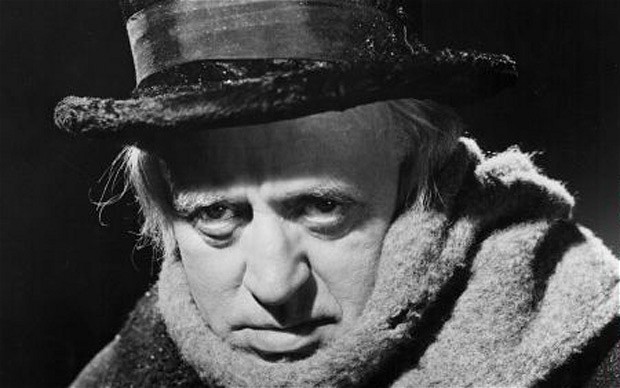
Episode 5: A Christmas Carol - All that Glitters

Sunday, August 31, 2014
Best of July/August 2014
Movies:
 It comes down to the wire between Ernest and Celestine, Becket, and The Dark Knight - three movies that are so wildly different as to make comparison nearly impossible. I'm going to have to go with entertainment value and choose Ernest and Celestine, a slight but lovely tale of friendship, art, and forgiveness. Unusual for the modern children's movie, and despite its palette of light colors, this film has quite a few harsher edges - this world isn't one without pain and death, though it treats them with a comic spin.
 A 2 1/2 hour film set in a silent monastery, Into Great Silence (Die Große Stille) is of those movies that really, really ought to be boring, but isn't. It's about silent people, not silence. The rain still patters on the rooftop, feet echo in the dusky hallways, wind whistles in the eaves, ponderous bells mark out the pace with solemn, inevitable regularity. The seasons change. We come to know the faces of these men, so anachronistically pious and dedicated. We come to see their thoughtful faith and sacrificial, unassuming love. It's a transcendent experience. Steven Greydanus's review.
TV:
 I probably shouldn't admit it, but I'm a sucker for sitcoms about elderly British people being mean to one another. Like Last of the Summer Wine or To the Manor Born, As Time Goes By makes the most of we're-getting-old humor, but has slightly more gravitas when handling the characters. It isn't afraid of earnestness, and amidst all the whimsicality and sex jokes (not too crass, m'dear, we're British) come intervals of calm sincerity. Also: Judi Dench (ever-elegant) and Geoffrey Palmer (ever-jowly) are terrific. Watch here.
 Agatha Christie's Poirot is over. My childhood goes with it. For those wondering (all two of you), I have not yet been able to bring myself to review Curtain. Mix of a) didn't like it as much as I wanted to, b) I haven't watched it again and c) I think I'm in denial. I'm currently nursing myself back to health watching the earliest episodes/David Suchet interviews (always a pleasant experience). Reviews: Elephants Can Remember. The Big Four. Dead Man's Folly. The Labours of Hercules.
Hannah Long
It comes down to the wire between Ernest and Celestine, Becket, and The Dark Knight - three movies that are so wildly different as to make comparison nearly impossible. I'm going to have to go with entertainment value and choose Ernest and Celestine, a slight but lovely tale of friendship, art, and forgiveness. Unusual for the modern children's movie, and despite its palette of light colors, this film has quite a few harsher edges - this world isn't one without pain and death, though it treats them with a comic spin.A 2 1/2 hour film set in a silent monastery, Into Great Silence (Die Große Stille) is of those movies that really, really ought to be boring, but isn't. It's about silent people, not silence. The rain still patters on the rooftop, feet echo in the dusky hallways, wind whistles in the eaves, ponderous bells mark out the pace with solemn, inevitable regularity. The seasons change. We come to know the faces of these men, so anachronistically pious and dedicated. We come to see their thoughtful faith and sacrificial, unassuming love. It's a transcendent experience. Steven Greydanus's review.TV:
I probably shouldn't admit it, but I'm a sucker for sitcoms about elderly British people being mean to one another. Like Last of the Summer Wine or To the Manor Born, As Time Goes By makes the most of we're-getting-old humor, but has slightly more gravitas when handling the characters. It isn't afraid of earnestness, and amidst all the whimsicality and sex jokes (not too crass, m'dear, we're British) come intervals of calm sincerity. Also: Judi Dench (ever-elegant) and Geoffrey Palmer (ever-jowly) are terrific. Watch here.Hannah Long
Wednesday, August 20, 2014
The Mirror - Zerkalo - (1975) - Movie Review


The
friend with whom I saw the film said it came into being because Tarkovsky was
trying to exorcise his recurring dreams (he was successful.) It’s true, the story
feels like a vast, puzzling experience of catharsis, though relief is mingled
with the bittersweet dissatisfaction of loss.
The
main character is Alexei “Alyosha”, a thinly veiled representation of Tarkovsky
himself. Many of Alexei’s problems stem from his troubled past, and he (or the camera,
at least) goes back to several periods in his life, attempting to untangle
memory from truth. Tarkovsky’s tracking shots, moving slowly through the doors
of a house, have an entrancing quality, drawing us into a world which feels
four-dimensional, beckoning us inside a fully-realized, tangible space.
Tuesday, August 5, 2014
A Peck on the Cheek (Kannathil Muthamittal) - Movie Review
.jpg)
When I approach foreign films, I always try my best to shelve cultural criticisms and accept it on its own terms. To some extent this is impossible, though it's much easier with European films than Asian ones. I have enough of an American need for emotionalism to feel like Russian characters are more like walking, talking existential crises than actual human beings. Indian films, on the other hand, indulge so deeply in sentimentality that I find it next to impossible to attach any real value to their emotion. Does this mean I can’t appreciate Russian or Indian films? No (for instance, I quite liked Kin-Dza-Dza!) but makes it harder. A Peck on the Cheek is difficult to review, just because it's so far outside my preferences and familiarity, but though my standards of measure may be Western, I have no others, and they are what I use.
Amudha is a precocious, petite, Sri Lankan version of Ferris Bueller, from hating her teacher, to delivering an introductory, breaking-the-fourth-wall monologue and being the center of a huge musical number. Everything is about Amudha; she's the heroine and she knows it.But the film isn't really about Amudha (or it shouldn't be); it's much bigger than her blissful childhood. After an opening, introducing a pair of star-crossed lovers (her real parents) in a war-zone, we slip entirely into Amudha's world, which has all the cheesiness and extravagance of a Disney cartoon. Still, the introduction remains as a solemn reminder that there are things happening outside this children's story, and unlike Ferris Bueller, Amudha will eventually have to engage with this.
Wednesday, June 18, 2014
The Book Thief - Movie Review

It's based on a book:
Liesel Meminger is a young girl in World War II Germany, who steals her first book from the frozen graveside of her brother. Abandoned, she is taken in by a pair of quirky but affectionate foster parents, with whom she is to endure the war. Her love of words and stories gives her hope in a world where childhood is quickly unraveling.
Thursday, February 13, 2014
Empire of the Sun - Movie Review
 If
you haven’t heard of this movie, don’t feel bad. Part of my affection for it
may be the fact that it’s one of Steven Spielberg’s little-known masterpieces, hiding
in the dusty corners of his 50-film history. It is based on J.G. Ballard’s novel Empire of the Sun, a semiautobiographical story of his childhood in China. Ballard’s stand-in is Jamie, a spoiled young Brit
living in the wealthy International Settlement, the only sector of Shanghai
which the Japanese have not occupied. When, after Pearl Harbor, the Japanese
invade, Jamie and his parents are separated, and he is thrown into a world for
which he is totally unprepared. For him, this is the real start of World War
II.
If
you haven’t heard of this movie, don’t feel bad. Part of my affection for it
may be the fact that it’s one of Steven Spielberg’s little-known masterpieces, hiding
in the dusty corners of his 50-film history. It is based on J.G. Ballard’s novel Empire of the Sun, a semiautobiographical story of his childhood in China. Ballard’s stand-in is Jamie, a spoiled young Brit
living in the wealthy International Settlement, the only sector of Shanghai
which the Japanese have not occupied. When, after Pearl Harbor, the Japanese
invade, Jamie and his parents are separated, and he is thrown into a world for
which he is totally unprepared. For him, this is the real start of World War
II.
I
think Empire of the Sun is a movie
that splits opinions. A lot depends on expectations. It might style itself as a
historical epic, or a commentary on war or race or other abstractions, but it’s
really about a little boy. It is not plot-driven but character-driven, like Lawrence of Arabia, it is a very long,
slow film in which the plot is really the hero. If one cannot empathize with
Christian Bale’s Jamie Graham, the entire movie falls apart.
I’ve
never had trouble with that. Jamie is, to me, a fascinating character. He is
spirited and imaginative, with a comic, conceited naivety that only children
with posh English accents can achieve. Thirteen-year-old Christian Bale is
extraordinary, throwing his entire heart into the character and delivering one
of the greatest child performances of all time.
Friday, January 10, 2014
Catch Me if You Can - Movie Review
 I remember years back when my dad told me about the remarkable exploits of Frank Abagnale Jr. Abagnale was little older than I was, but he led a successful life of crime, impersonating an airplane pilot, a pediatrician, and a lawyer. I was fascinated.
So apparently was Steven Spielberg, who adapted the conman's life into a film in 2002, starring Leonardo DiCaprio and Tom Hanks.
Frank Jr. starts his life in the center of the 1950s American Dream. His father (a very good Christopher Walken) is a successful businessman, his mother a beautiful Frenchwoman. But one day, Frank Sr. can't charm his way out of his troubles with the IRS. It turns out Mrs. Abagnale isn't so charmed with Frank Sr. as she is with the American Dream, and the cracks are beginning to show. Divorce and loss of innocence. Frank Jr. can't take it, so he starts to run, desperate to renew his lost childhood. DiCaprio is particularly good in the role, concocting just the right mix of charm, innocence, and immaturity.
Subscribe to:
Posts (Atom)